37 million tons of cargo moved on Russia's Arctic route in 2025
Sanctioned tankers stalled in ice at a key choke point this summer, complicating Moscow's plans to nearly double shipping volumes by 2030.
By Pavel Bell ·
Russian President Vladimir Putin stated in September that 37 million tons of cargo traveled along the Northern Sea Route in 2025. He made the remark during the launch of the Vostok Oil project on the Taimyr Peninsula. Putin predicted that this volume would almost double by 2030.
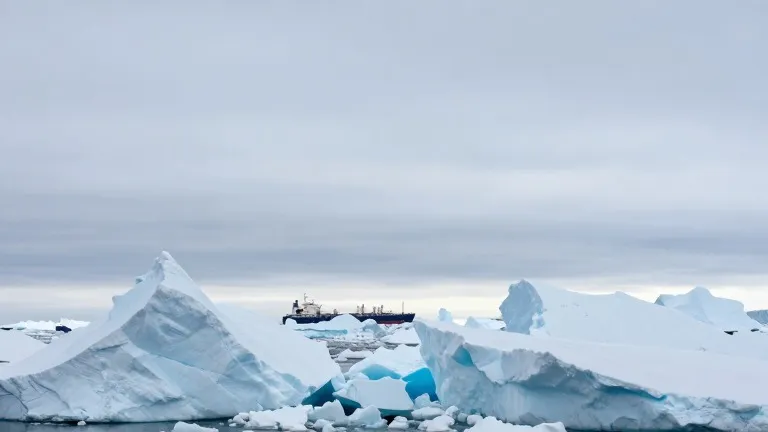
The route serves as a shorter path for Russian crude oil and liquefied natural gas to reach Asian markets. It bypasses Ukrainian drone threats and potential European naval blockades. However, a July incident in the Vilkitsky Strait exposed logistical limits. Several sanctioned tankers became trapped in ice in this 55 kilometer wide passage between the Siberian coast and Bolshevik Island.
Two nuclear-powered icebreakers were days away from the stuck vessels. Only one tanker successfully navigated the strait. The remaining ships waited up to two weeks for assistance. After the icebreakers arrived, the vessels still could not pass and eventually took an alternative route.
Ksenia Vakhrusheva, head of the Arctic project at the environmental group Bellona, explained that melting ice can pack tightly in narrow areas. She noted that this phenomenon blocks ships that lack specific ice-class ratings. Her comments illustrate that reduced ice coverage does not necessarily simplify navigation.
Independent data suggests the cargo volume is lower than presidential claims. The Norway-funded Center for High North Logistics reported that Russia shipped about 2 million tons of mostly crude oil along the full route to Asia by the end of September. This amount equates to roughly 15 million barrels. Reuters reported that total shipments reached about 20 million barrels by mid-October.
Tomas Alexa, a senior analyst at Ambrey, described this increase as a surge from a relatively low base. The 2025 volume represents a 50 percent rise compared to the previous year but accounts for only about 1 percent of Russia's seaborne oil exports. Western sanctions complicate maintenance and construction efforts for Arctic-capable vessels. Spare parts and materials often require third-party routing, and repair services from Norwegian, Danish, and Dutch firms are no longer available.
Other nations are testing the route's viability. South Korea reported on October 22 that its first container ship used the Northern Sea Route. Officials cited difficult conditions, including large ice floes in the Bering and Vilkitsky straits. China completed its first scheduled container service to Europe along this path this year.
Catherine Sendak of the Center for European Policy Analysis noted that Russia treats much of the Arctic as an inner waterway. Questions remain regarding tolls and service offerings for commercial vessels. Security concerns are rising as EU foreign affairs chief Kaja Kallas described the region as a front line of global power competition on October 21. NATO launched the Arctic Sentry mission in February, and the United States announced plans to expand its military presence in Greenland last month.
Source: RFE/RL