Sorbonne Model Solves Mars Cloud Mystery With 100,000x Humidity
A new study in Nature Geoscience shows the Arsia Mons cloud forms via a rare ice process requiring humidity levels far exceeding Earth's maximums.
By Pavel Bell ·
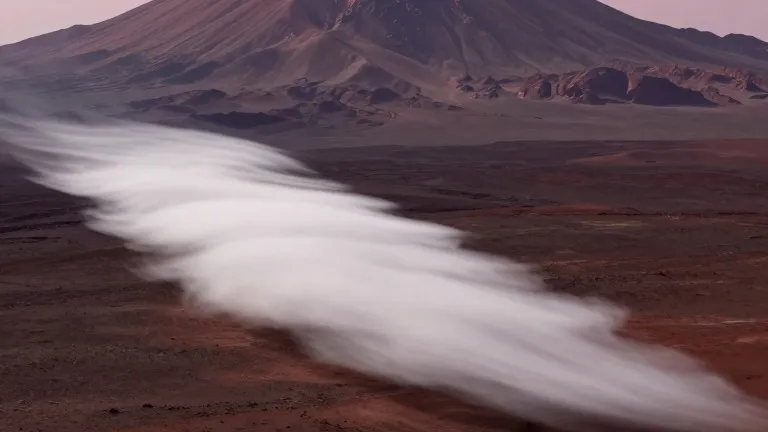
Relative humidity levels exceeding 100,000 times the highest values ever recorded on Earth may be required to form a specific Martian cloud. This finding emerges from a new modeling study published in Nature Geoscience that attempts to explain the Arsia Mons Elongated Cloud. The research suggests the cloud relies on a physical process that has never been directly observed in any planetary atmosphere.
The cloud appears near the Arsia Mons volcano during Martian spring and summer. It stretches over 1,000 miles, a distance comparable to the straight-line span between New York and Kansas City. The formation grows longer through the morning and dissipates by afternoon, a cycle that repeats over several months. A space probe first recorded this feature in 2018, but scientists have struggled to identify a plausible mechanism for its existence until now.
Jorge Hernández-Bernal, a planetary scientist at Sorbonne Université in Paris, led the research team. He stated that previous simulations failed to reproduce the cloud because they lacked what he called exotic physics. According to Hernández-Bernal, this process appears in textbooks but is often treated as theoretical. He noted that once the team included this mechanism, the cloud emerged in the model exactly as expected.
The proposed mechanism is homogeneous nucleation. Unlike Earth clouds, which form when water vapor condenses around dust or salt particles, this Martian cloud forms when vapor turns directly into ice crystals without seeds. Hernández-Bernal compared the phenomenon to condensation appearing in the middle of a room rather than on a window. He described the discovery as wholly unexpected.
Creating these conditions requires a temperature drop of 30 degrees Celsius within 10 minutes, alongside the extreme humidity levels. The Arsia Mons volcano, which stands 65,000 feet high, plays a central role in generating these conditions. When wind encounters the volcano, it creates a wave that lifts moist air into the upper atmosphere within minutes.
The study indicates that while scientists previously assumed similar nucleation could occur in the upper atmospheres of Venus and Earth, it has never been observed. The extreme humidity requirement likely explains the lack of prior detection. Hernández-Bernal noted that far less is known about the Martian atmosphere than about Earth's, making the successful reproduction of the cloud a notable achievement. He described the result as remarkable.
The study provides a new framework for understanding atmospheric processes on Mars. It suggests that standard assumptions about cloud formation do not apply in all planetary environments. The findings challenge previous models that relied on conventional condensation processes. The work offers a potential explanation for a long-standing astronomical mystery.
Source: Wired