25 to 30 Settlers Built Outpost on Majd al-Krum Land
Villagers in northern Israel view the brief encampment as a test run for far-right plans to expand Jewish settlements in the Galilee before Tuesday's vote.
By Sergio Morris ·
Palestinian residents of Majd al-Krum in northern Israel describe a settler outpost built on their land last month as a direct test of what could follow if the far right wins Tuesday's election.
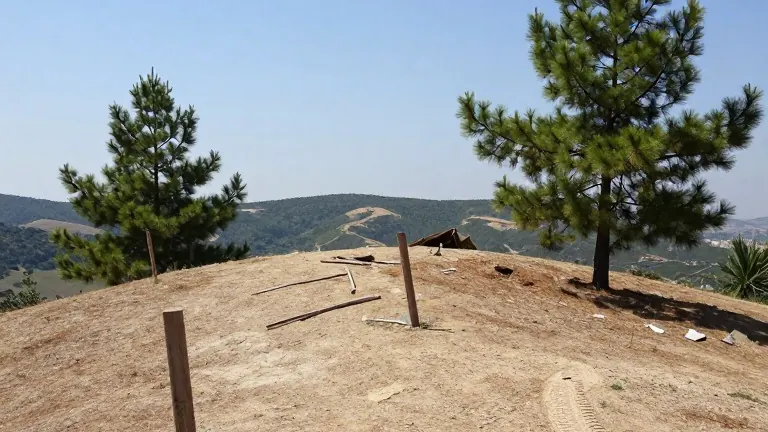
In late August, settlers from the occupied West Bank began constructing a camp on the pine-covered hilltop of al-Rus. They cited a Jewish National Fund permit for livestock grazing, though villagers reported no animals were present. Within a week, the camp housed between 25 and 30 people, complete with a kitchen, toilet, water line, and electricity, according to lawyer Hussein Mannaa, a member of the town's Popular Committee. Villagers noted this was among the first such attempts on the Israeli side of the Green Line.
Starting September 13, hundreds of Palestinians from Majd al-Krum and the surrounding region visited the site daily, even after police closed the road. They arrived on foot, by horse, and in off-road vehicles. Anas Sgaier, a 21-year-old law student and youth organizer, recalled seeing a woman in her 80s walking for 50 minutes with her husband to show her presence. By September 16, after nearly a week of peaceful protests, the JNF ordered the tents removed.
The episode has been linked to the campaign of Finance Minister Bezalel Smotrich, who has promised to 'Judaise' the Galilee and repeat the settlement expansion seen in the West Bank. On August 27, he posted a plan for one million more Jews and 40 new Jewish communities in the Galilee and al-Naqab. Husein Khalaily, a 50-year-old economic consultant, called the al-Rus camp a 'pilot' experiment, stating that the language used is now clear.
Tensions persisted after the camp's removal. Smotrich campaigned in the village accompanied by police and a water cannon, while local committees persuaded young residents to avoid confrontation. On September 18, police arrested a 32-year-old resident over alleged contact with a Lebanese agent. Smotrich subsequently described Galilee residents as being 'in the atmosphere of October 6.' Mannaa argued that these provocations aim to force a confrontation, saying 'chaos benefits them.'
The JNF has stated that the grazing initiative will move to another plot about 500 metres away, on land villagers also consider theirs. Residents reject any relocation, with Mannaa saying they will not accept 'even one tent.' The JNF, Israeli police, and the Finance Ministry did not respond to requests for comment.
The incident may influence voter turnout. Polls indicate that neither main Zionist bloc can reach 61 seats without Arab party support. Palestinian participation has ranged from 45 to 65 percent in recent years, but organizers expect it could reach 70 to 75 percent, a level last seen in 1999. Mannaa predicts Majd al-Krum will 'go past 80 percent.' Khalaily, who has voted only once, now urges people to vote to remove 'these prominent racists,' though he sees little difference between the current government and its likely replacement.
Not all residents agree on the strategy. Sgaier will still boycott the vote, arguing that the village solved its problem by taking to the street rather than through the Knesset. He sees little difference between the two Zionist blocs but notes that the protests engaged people who were previously uninvolved. The settler tents are gone, leaving only sparse remains and Hebrew graffiti. Villagers continue to climb the mountain daily, where families barbecue and schoolchildren play. Singer Khaled Kewan, 27, recorded the song 'Ibn Bladi' during the protests and warned that expansion efforts are 'coming not just for Majd al-Krum, but for the whole Galilee.'
Source: Al Jazeera