Early Voting Surges as Trump and Clinton Rally in the South
Ballot counts in key states exceed 2022 levels, while a Justice Department probe into an Alaska election scheme expands.
By Pavel Bell ·
President Donald Trump and former President Bill Clinton campaigned in separate Southern states on Friday, urging voters to cast ballots in the midterm election that will determine control of Congress.
Trump addressed Republican supporters in Daytona, Florida, calling the upcoming vote the most important midterm in history. He told the crowd he had planned to rest after 28 days of campaigning but rescheduled rallies for Iowa and Kansas that Sunday.
"I thought this was going to be my last one, Byron," Trump said to Republican gubernatorial candidate Byron Donalds. "I thought I could relax. Twenty-eight days in a row of this crap is a lot."
Clinton spoke in Tupelo, Mississippi, hours earlier. He invoked former Republican President George W. Bush to argue that democracy is self-correcting. Clinton asked voters to support Democratic Senate candidate Scott Colom.
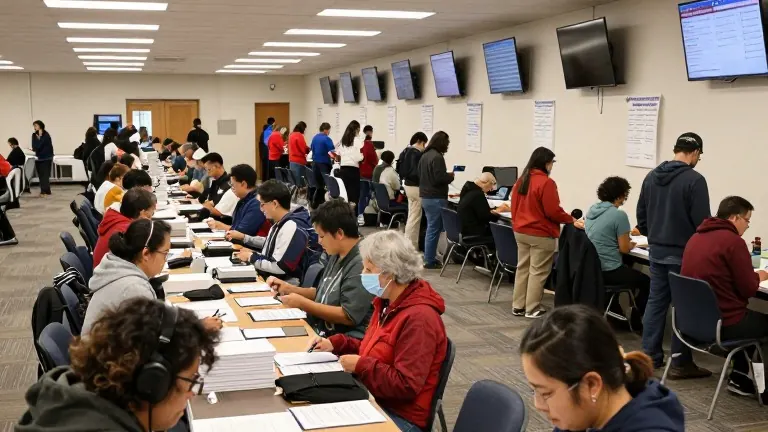
An Associated Press analysis of voting data shows nearly 10 million more Americans cast ballots five days before Election Day than in the same period in 2022. Early voting in Iowa and Kansas is up roughly 30 percent. Texas has seen a 50 percent increase, with more than 6.3 million Texans voting early as of Wednesday compared to 4.2 million in 2022. South Carolina, which is choosing a successor to the late Senator Lindsey Graham, reports an 83 percent increase in early votes.
The Justice Department confirmed a criminal investigation into a potential scheme in Alaska to confuse voters. U.S. Attorney Michael Heyman stated that law enforcement assets were surged to the state this week. The probe examines a candidate named Dan J. Sullivan, who shares a name with the incumbent Republican Senator, Dan Sullivan. The New York Times reported that the campaign of Democratic candidate Mary Peltola appeared involved in recruiting the new candidate. Peltola denied knowledge of the effort on Thursday. The Justice Department aims to isolate ballots ranking Dan J. Sullivan to measure voter confusion.
In Michigan, tensions resurfaced between progressive Abdul El-Sayed and Rep. Haley Stevens. Stevens, who lost the August primary to El-Sayed, appeared on CNN to say she would vote for El-Sayed but urged him to repair ties with Jewish and Black voters. Hours later, her fiancé said he would vote for Republican opponent Mike Rogers. Stevens released a statement on social media criticizing El-Sayed's handling of an advertisement linking U.S. support for Israel to rising grocery prices. El-Sayed responded by saying the focus should be on defeating Rogers. Rogers praised Stevens on X, calling her a courageous leader and stating that El-Sayed's response showed he did not care about the concerns.
Source: The Aegis