Gerlach and Iovino Determine Dark Matter Black Holes Must Be Under 100 Billion Suns
Analysis of the cosmic microwave background reveals that supermassive objects cannot form the majority of the universe's unseen mass.
By Hugo Khalil ·
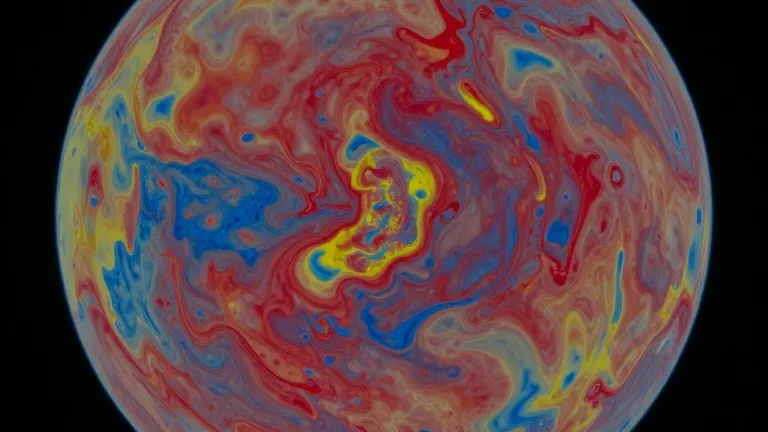
Physicists Christopher Gerlach and Antonio Iovino determined that black holes exceeding 100 billion solar masses cannot constitute a major portion of dark matter. The study, set for publication in Physical Review Letters on October 26, places a hard upper limit on the size of these hypothetical objects. This finding addresses a long-standing question about the composition of the invisible substance that holds galaxies together.
Dark matter accounts for approximately five-sixths of all matter in the universe. Scientists proposed its existence decades ago to explain why galaxies rotate without flying apart. While the exact nature of this material remains unknown, black holes have been a leading candidate due to their immense gravity and low visibility. The researchers specifically examined 'stupendously large black holes' with masses ranging from 1 million billion to 10 million billion suns.
No black hole of this scale has been detected to date. The largest known object in the universe weighs about 36 billion times the mass of the sun. Because surveys of many galaxies have not turned up these massive entities, the team sought to test if they could still make up a substantial fraction of dark matter. They analyzed the cosmic microwave background, the oldest light in the universe, to look for specific patterns.
This light was released when the universe was 380,000 years old. During the first 380,000 years after the Big Bang, the cosmos was filled with hot plasma that trapped photons. As expansion cooled the universe, atoms formed and light was able to travel freely. Gerlach described this radiation as a snapshot of the infant universe covering the entire sky. Iovino noted that the temperature of this background varies by about one part in 100,000 from place to place.
These temperature fluctuations reveal how matter was distributed in the early universe. If dark matter consisted of a few gigantic black holes, the universe would appear grainy on very large scales. The data showed that the background lacks this specific graininess. Nicholas Leister, a theoretical physicist at the Mainz Institute for Theoretical Physics, stated that these results mean such black holes cannot be a significant part of the dark matter budget.
The authors clarified that the finding does not prove these enormous black holes do not exist. It only indicates they are not a major component of dark matter. The team noted that smaller black holes, roughly the size of asteroids, remain a possible candidate. They are currently investigating whether these smaller objects can also be ruled out as a primary constituent of the universe's mass.
Source: Space.com