Treeshrews and Vision: Mapping How Brains Learn Meaning
Cornell researcher Madineh Sedigh-Sarvestani argues that perception is built from body movements, not just sensory input, a theory she is testing with acrobatic small mammals.
By Hugo Khalil ·
The brain does not receive the world as a finished product. It receives raw signals from the eyes and ears, then has to construct meaning from those signals. Madineh Sedigh-Sarvestani, an assistant professor of neurobiology and behavior at Cornell University, proposes that this construction process relies on a sensory-motor dictionary. This dictionary maps body movements to sensory changes, allowing the brain to interpret its surroundings.
Sedigh-Sarvestani presented this theory at a Bodian Seminar hosted by the Zanvyl Krieger Mind/Brain Institute on Oct. 19. She argued that sensation is not pre-labeled with meaning. Instead, the brain learns what sensations mean by observing how they change when the body moves. "Our core hypothesis is that sensation doesn't come pre-labeled with meaning," she said. The dictionary is rooted in these physical interactions.
A common example of this gap between sensation and perception occurs in patients recovering from cataract surgery. After years of limited vision, these individuals can immediately detect light once the clouded lenses are removed. However, they often require weeks to recognize familiar faces and objects. The eyes work, but the brain has not yet updated its dictionary to interpret the new visual data.
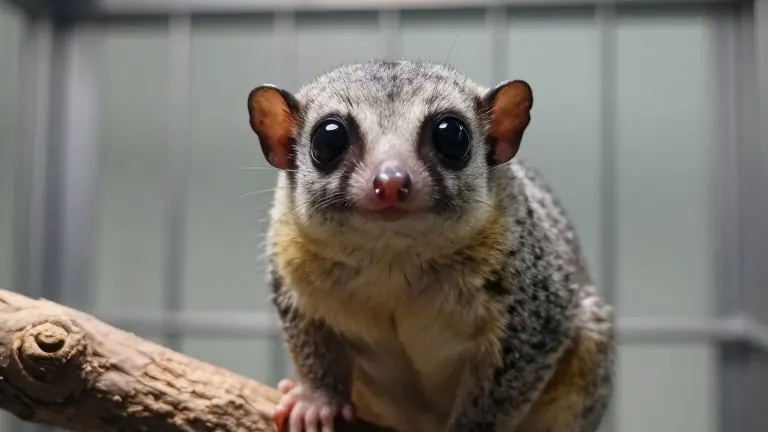
To test how this dictionary forms, Sedigh-Sarvestani studies treeshrews. These small mammals have eyes positioned on the sides of their heads, similar to mice and rats. This placement usually suggests that an animal relies on head movements to shift its gaze. Primates, by contrast, can move their eyes independently of their heads. Treeshrews appear to occupy an unusual position between these two groups.
In experiments with head-fixed treeshrews, Sedigh-Sarvestani observed that the animals made small, five-degree eye movements. Ninety percent of these movements occurred without any head movement. "Much of their visual system seems specialized for sampling the binocular field in front of them," she noted. This is surprising for a small, nonsocial animal that does not need to read facial expressions or use a smartphone.
The ability to move the eyes independently of the head may be linked to the treeshrews' acrobatic lifestyle. Sedigh-Sarvestani showed footage of a treeshrew leaping between branches in her lab. The animal executed an almost 180-degree rotation in the air to land on the next branch. To succeed in such a jump, the animal must move its body in one direction while keeping its eyes fixed on a landing point. Independent eye movements allow the treeshrew to maintain visual focus during complex rotations.
To determine if movement actually shapes perception, the lab altered the relationship between the animals' movements and visual input. Researchers trained treeshrews to move their gaze toward a target. They then reversed this relationship so that moving the eyes in one direction caused the target to move in the opposite direction. The animals adapted to this new rule within weeks.
The lab is now pursuing more extreme tests using treeshrew-sized goggles with inverting prisms. These devices flip the animals' visual world upside down. This forces the animals to relearn the relationship between their movements and what they see. While humans can easily undergo this type of experiment in psychology classes, it is difficult to execute on animals.
Initially, the treeshrews struggled in the inverted environment. They hesitated to perform their usual jumps. Over time, they adjusted their movements and regained the ability to execute complex behaviors like jumping between branches. Sedigh-Sarvestani noted that these animals are highly mobile and their movements require vision. This makes them good candidates for studying how the brain updates its sensory-motor dictionary when the rules of the environment change.
Source: The Johns Hopkins News-Letter