1,950 Residents Displaced as Israeli Forces Seal Hebron
Following a checkpoint attack that killed two soldiers, military sweeps in Hebron have emptied the Ein Deir Baha district and left the city isolated ahead of Tuesday's election.
By Hugo Khalil ·
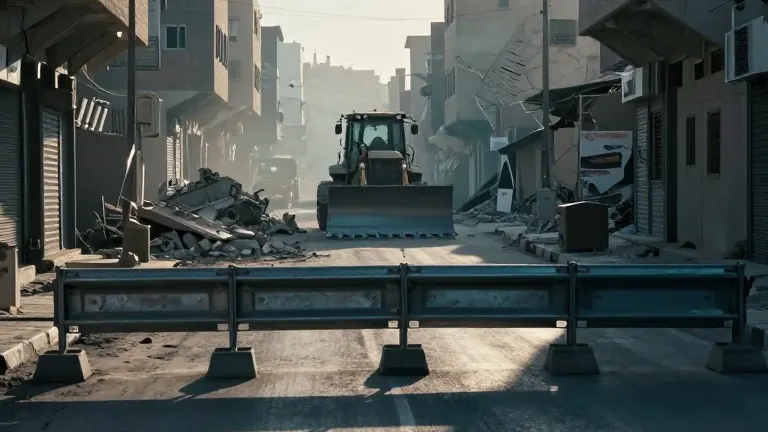
The daily routine for nearly 2,000 residents of Hebron ended in the middle of the night on Saturday. Following a shooting at a military checkpoint on Friday that left two Israeli soldiers dead, the Israeli army sealed off the West Bank’s largest city. By Sunday, heavy steel barriers blocked all roads to and from the city of 250,000, allowing only pedestrians to cross. The isolation came just days before Israel’s general election, placing the West Bank at the center of Prime Minister Benjamin Netanyahu’s campaign on security.
The military response was immediate and physical. In the Farsh al-Hawa neighborhood, closest to the site of the attack, bulldozers flattened an industrial zone. By Sunday morning, car workshops and a large ceramics plant were reduced to rubble. In the neighboring district of Ein Deir Baha, the focus shifted to residential homes. The army alleged that at least one of the two gunmen killed in the Friday attack lived there. Residents were ordered to leave, and by Sunday evening, the area had been cleared of its population.
Fahed Ahmaro, the imam of the local mosque, described the evacuation as a forced departure. He stated that military vehicles with loudspeakers woke him around midnight, ordering homeowners to leave immediately for their safety. Ahmaro, whose family of 30 lived in the house, moved his elderly mother and grandchildren to a relative's home. When he returned to collect belongings, a neighbor told him the army had blown up the gates. Ahmaro said he was buying clothes for his grandchildren on Sunday, unsure how long his family would remain displaced.
Abdul Halim al-Tamimi, 77, said the military arrived at his home at 1:30 a.m. and gave his family 10 minutes to pack. He recalled an intelligence officer warning that if they refused to leave, they would be displaced in the manner of Gaza. By 3:00 a.m., his family was outside. By Sunday morning, his villa was draped in Israeli flags and served as a temporary army headquarters, surrounded by military vehicles. The army stated that residents left voluntarily and that civilians were permitted to evacuate temporarily. Ahmaro rejected this characterization, asking why he should leave his own house.
The Hebron municipality reported that 370 families were displaced by the sweep through Ein Deir Baha. The Israeli army linked the residents to the Jaba'a clan, which it described as being associated with Hamas and numbering about 2,000 people. Residents of the district pushed back against these figures, stating the clan numbers at most 150 people and has no known reputation for radicalism. Al-Tamimi, who is from a different clan, suggested the operation was designed for election publicity.
The blockade has created immediate logistical problems for those still inside the city. Wasam Sadi, a delivery truck driver, arrived at a checkpoint on Sunday with a smashed windshield and glass in his eyes. He said settlers had attacked him at a nearby junction. Yousef al-Jabari, the mayor of Hebron, described the measures as collective punishment. He noted that people were dragged from their homes and that media outlets had been kept out of the affected district. Palestinians in the occupied West Bank are not eligible to vote on Tuesday, but the election outcome will determine the political direction of the government overseeing their daily lives.
Source: The Guardian