Alliance Costs: North Korea’s drone boom raises the price of defense for Seoul
Russian technical support is enabling Pyongyang to mass-produce cheap attack drones, forcing South Korea and its partners to consider expensive upgrades to their air defense networks.
By Sergio Morris ·
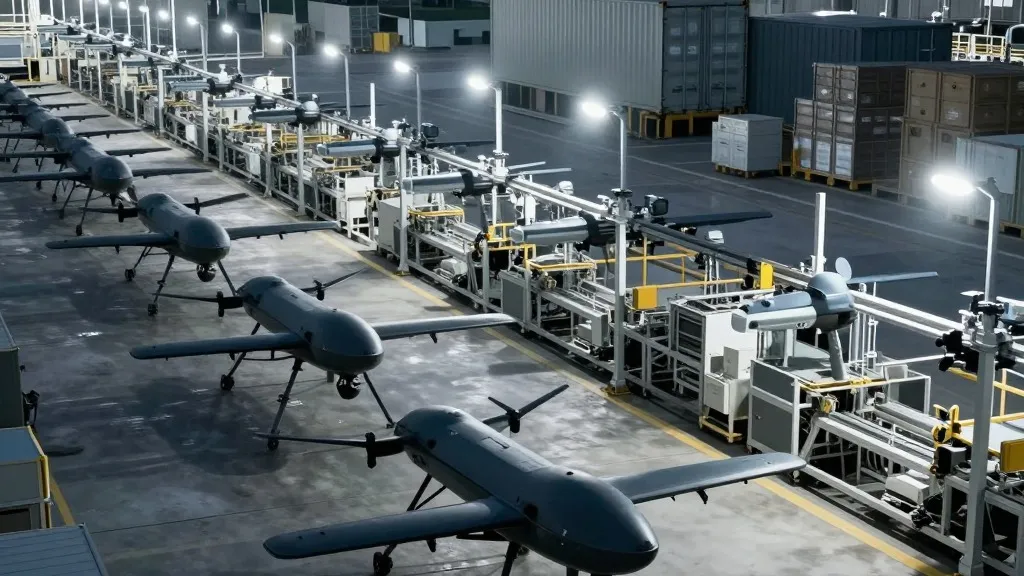
The cost of defending the Korean Peninsula is rising as North Korea accelerates the production of inexpensive attack drones.
According to a report by The New York Times, Pyongyang has begun mass-producing these unmanned systems with significant assistance from Russia. The partnership involves a direct exchange where Moscow shares military developments with the North in return for soldiers, workers, and weapons. This cooperation has intensified since Russia launched its full-scale invasion of Ukraine, leading to a period of rapid modernization for North Korea’s armed forces.
The financial implications of this shift are becoming clear in recent military exercises. Last month, North Korea conducted a drill where a swarm of drones attacked a target island simultaneously with cruise and ballistic missiles from various directions. The report highlights that Pyongyang has studied conflicts in Ukraine and the Middle East to understand how low-cost drones can saturate and overwhelm expensive air defense systems. Analysts suggest that this evolving tactic will eventually force South Korea and its allies to redesign their defense infrastructure, a process that comes with substantial capital expenditure.
South Korea has responded to these developments with its own high-cost investments. In early October, the North tested a tactical ballistic missile it claims can carry a nuclear payload. While Seoul and Tokyo estimated the range at approximately 700 km, Pyongyang asserted a range of 1,000 km. Five days later, South Korea conducted its first test of a hypersonic ballistic missile, a move observed by President Lee Jae Myung. This response signals growing concern in Seoul over the rapid pace of North Korean missile technology and the need to maintain a technological edge.
The technical transfer from Russia is a key driver of these improvements. Analyst Anton Ponomarenko noted that access to Russian deployment data and feedback has helped North Korea enhance the accuracy and maneuverability of its weapons. Ponomarenko described the resulting threat to South Korea as more substantial. This technological uplift is part of a broader industrial collaboration that includes the use of North Korean labor in Russian facilities.
Bloomberg reported in September that up to 25,000 North Korean citizens are working at Russian military plants, notably in Alabuga, Tatarstan, where they produce military drones. Additionally, a North Korean missile unit capable of operating 120 ballistic missiles and six launchers has begun deploying in western Russia. This unit is potentially positioned for strikes against Ukraine, further integrating the two militaries' operational capabilities.
The current news cycle follows a series of recent announcements regarding this partnership. In August, Russia requested KN-30 ballistic missiles from North Korea. In June of this year, Pyongyang announced tests of a modernized 240mm multiple-launch rocket system, a tactical ballistic missile, and a 155mm long-range artillery shell. These developments underscore a trend of increasing interoperability and industrial output between the two nations.
Looking ahead, the focus will be on how South Korea and its allies budget for the necessary air defense upgrades. The shift toward drone swarms suggests a future where defense spending must account for volume and saturation tactics rather than just high-value targets. The ongoing deployment of North Korean units in Russia and the continued exchange of technology will likely shape the strategic balance in the region for the coming years.
Source: Ukrainska Pravda
More Business · World news · Bad Service · Report a business · Got a Story?