Moon water supply limits permanent cities to 10,000 people
A new analysis indicates that lunar water reserves can sustain a small settlement for centuries, but would run out for a million residents within a century.
By Pavel Bell ·
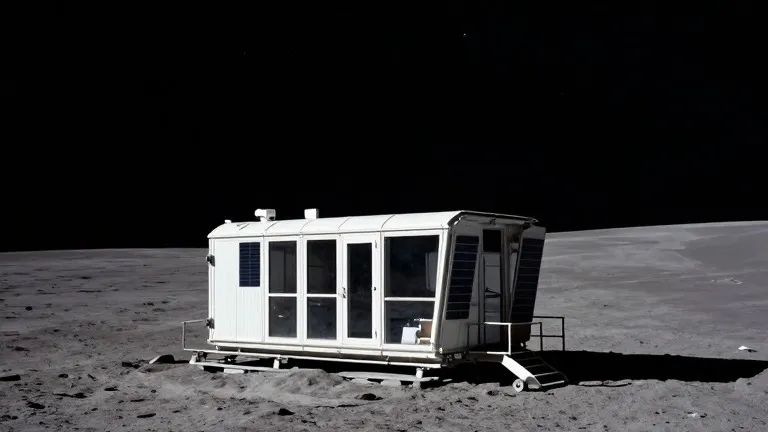
Plans for large lunar communities face a physical constraint: there is not enough water on the moon to support millions of residents for long. A study published this week in the journal Frontiers in Space Technologies calculates that lunar water reserves would only last about 100 years for a population of one million. For a smaller group of 10,000 people, the same water supply would remain viable for centuries.
The findings challenge recent statements by major space industry leaders. In February, SpaceX CEO Elon Musk posted that his company was pivoting from Mars to build a self-growing city on the moon in under ten years. Blue Origin CEO Jeff Bezos has separately stated that millions of people will live in space by 2045. The new analysis suggests these timelines and population targets require solving a major resource shortage.
Martin Elvis, a senior astrophysicist at Harvard University's Smithsonian Astrophysical Observatory, co-authored the paper with Jonathan McDowell, an honorary professor at the Durham University Space Research Centre in England. Their work focuses on two critical resources: power and water. The researchers determined that power generation is solvable. Solar and nuclear sources could provide enough energy for one million people on the lunar surface.
Water is the limiting factor. Current estimates suggest roughly one billion tonnes of water exist on the moon, mostly in permanently shadowed regions at the poles. Elvis described this total as comparable to an aquarium the size of Central Park filled until the Statue of Liberty is just underwater. He called it a small lake that cannot supply a big city for very long. The 100-year estimate for one million people assumes a 98 percent recycling rate, the same rate currently achieved on the International Space Station.
The baseline estimate may be too optimistic. Elvis believes the total of one billion tonnes is likely 20 or 30 times too high. He estimates that only one percent of that figure is reliably available for use. Under that stricter calculation, water for one million people would last only one year. Gordon Osinski, a professor of planetary geology at Western University in London, Ont., noted that satellite measurements have uncertainties. He suggested the water might exist as sub-millimetre ice crystals mixed into soil, similar to Arctic permafrost, making extraction difficult.
McDowell said the results should not discourage exploration. He argued that the truth is never negative, and that attempting projects that are not feasible is the real problem. The study provides a concrete baseline for planners who are designing infrastructure for future lunar habitats.
Source: CBC News